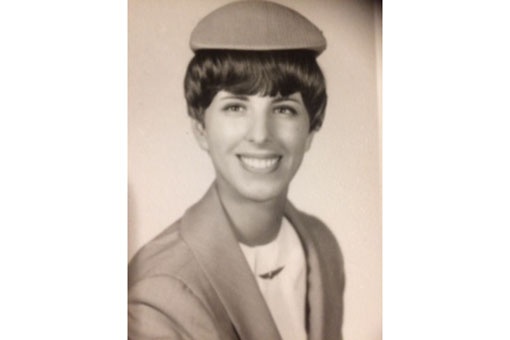
The Stewardess' Tale
Published by
Sean Mobley
on
Before there were flight attendants, there were stewardesses, and in this AMA episode we talk to Mary Hoy, who served as a stewardess aboard United Airlines from 1967-1973, who answers questions from our social media followers. Hoy describes the joys and struggles of being a stewardess during this Golden Age of Aviation and recalls experiencing rapid changes in aviation technology as she worked aboard a variety of planes from the Douglas DC-6 to the Boeing 747. And Hoy doesn’t shy away from detailing the sexism she encountered as well, like the time airlines started hiring men as flight attendants and she overheard the pilot declare, “I don’t know why a man would stoop so low to do a woman’s work.”
Transcript after the player.
Want to check out one of the planes that Hoy served aboard? Come aboard the 747 next time you’re at the Museum. https://www.museumofflight.org/aircraft/boeing-747-121
Host: Sean Mobley
Producer: Justin Braegelmann/Keny Dutton
Webmaster: Layne Benofsky
Content Marketing Manager: Irene Jagla
Transcript
00:00:00
SEAN MOBLEY: The Flight Deck is made possible by the generous donors supporting the Museum of Flight. You can support this podcast and the Museum of Flight's other initiatives across the United States and the world by visiting museumofflight.org/podcast.
[Music]
SM: Hello, and welcome to The Flight Deck, the podcast of the Museum of Flight in Seattle, Washington. Today's episode was previewed several months ago as a special thank you to donors who participated in the Give Big Initiative. In gratitude for their support, we released this episode just to those who gave to the museum through that campaign a few months early, and now, I am excited to share it with everyone. On today's episode, I sat down with Mary Hoy, a docent at the museum, who worked as a stewardess for United Airlines back in the days when they were called stewardesses. Mary answered some questions from listeners and museum supporters like you about her time in the air, giving a refreshingly honest look at the joys, along with the very real struggles, she and the women she flew with faced in the friendly skies.
[Music]
00:01:22
SM: Mary, thank you so much for joining me today.
MARY HOY: You're quite welcome. It's a pleasure to be here.
SM: You were a stewardess/flight attendant.
MH: Yes, I'd like to say in a past life. It's been quite a while, but from 1967 to 1973, I was a stewardess for United. And the name flight attendant came in just as I was leaving.
SM: What prompted the change in name?
MH: I believe it was because, in the early 1970s, the airlines started hiring men as flight attendants all over the United States. United had Hawaiian gentlemen that were flying on their flights from Honolulu to San Francisco and Los Angeles from the 1940s after World War II, but they were the only flights that they could fly until the early '70s.
00:02:17
MH: When the other gentlemen got hired, then they could fly anywhere they wanted to.
SM: It's unique in many ways in the United States to have a career dominated by women.
MH: That's right. But before there were women, they were men.
SM: Of course.
MH: They were flight attendants, especially Eastern Airlines because the president of Eastern Airlines preferred to have men as flight attendants until he was pressured by the public to hire women.
SM: Why do you think that was?
MH: I think the society at the time. There were a lot of businessmen that were flying, and they preferred to have nice, young ladies serve them.
SM: I appreciate your frankness. Well, on that note, we do have some questions that were submitted to you from listeners and fans of the museum, so we're going to jump into some of those. This one came over our Instagram account from @mnpilot493. They asked, "How did you see the change in aircraft over the years as a flight attendant?"
00:03:19
MH: A very good question. I saw a lot of changes. When I started with United, United was still flying the Convair 340, which was a twin-engine, 40-passenger aircraft. They were still flying the Douglas DC-6, which was a four-engine propeller aircraft, of which I flew some flights on, and I flew many flights in the Douglas DC-8, the Boeing 727, the Boeing 720, nd as the years progressed on the 747.
SM: This question also came from our Instagram account from @amyraylady, asked, "Did airlines treat their employees with more respect and better working conditions?"
MH: That is a very interesting question. In our culture today, we talk about respect and working conditions quite a bit. At the time though, we didn't think that way. We were just so thrilled to be stewardesses, and we knew how special we were. And we went through our training. We were thrilled to get on an airplane to help people, and that was how we lived. We didn't think about how people respected us. And on the working conditions, we just accepted things as they were.
SM: People might not realize it, but flight attendants today are there primarily for safety. That's the main reason. Was that true when you were a stewardess?
MH: Most definitely. We always felt that, when the passengers came onto the airplane, we treated them like they were in our living room, and we treated them with respect and as family. There was a lot more service-oriented functions at the time.
00:05:07
MH: We served a lot more meals on a lot shorter flights than they do today. We didn't have the carts going up and down the aisle like they do today. We had, if we had, like, say for a liquor service, we had a small cart. It was very small. We would go through the cabin first, and then, all of the meals, we would run out by hand two at a time. Picking them up on a short flight, we might have to pick up six to eight at a time. I remember on a flight, on a Super DC-8, and those airplanes carried close to 200 passengers from Las Vegas to Denver, which is just over an hour.
SM: That's a pretty quick jump.
MH: And it was on the schedule that we were to serve drinks and lunch. We knew that there wasn't going to be enough time for everything. We were able to get the meals out. Now, we have to pick them up. Now, I'm bent over. I'm picking up eight trays at a time, and there was this little boy sitting in an aisle seat about eight years old. And I'm looking up as I'm running down the aisle, and he put his arm out in the aisle. And luckily, I saw him, and I stopped. And I said, "Don't do that." I went, picked up some more, went down the aisle. He did it again, and I said, "Listen. You do that again, I'm going to make you get up and help me."
SM: Did he do it again?
MH: He did not do it again. No.
SM: Another question came in from our Facebook feed. James Radson [phonetic] [00:06:35] asked, "Compared to your experiences as a flight attendant, what do you imagine would be more challenging about that work today? What might be easier than what you experienced?" So, comparing it to a flight attendant working in 2018 to a flight attending working in 1969. You have the slight advantage of seeing some of the modern planes, like the Boeing 787 out in the Aviation Pavilion. When you walk through that, what do you think of it from a flight attendant's perspective?
00:07:06
MH: Well, number one, it's huge. You know, and as I look at it, you know, from a service standpoint how easy is it for us to serve the passengers and how comfortable are the passengers, and that's one thing about the 787, the new aircraft. The air circulating through the cabin is much better. The lighting is much better. It's just more comfortable for the passengers.
SM: You recently flew yourself. When you fly, do you chat with the flight attendants or do you notice them? I'm just curious from that perspective.
MH: Yes, I do. I notice the way they do their cabin announcements. I remember one flight. I was on a short flight from Providence, Rhode Island to Long Island, and it was a smaller aircraft with 30 passengers. And there was a flight attendant. I imagine she was probably in her 40s, and I think probably in a past life she was probably a physical education teacher.
SM: Okay.
00:08:11
MH: And she was wearing a t-shirt and Bermuda shorts, and she made a very good announcement. Everybody in that cabin listened to her. She said, "Listen to me. I am going to help you if you need help, and I want everybody listening." And everybody listened, and that was a pleasure. And when I got off the airplane, I said, "You know, that was the best I've ever heard, and I've made hundreds of announcements." One of the things I would say was, "In the seat pocket in front of you, you'll find a copy of the Mainliner magazine that you're welcome to take with you as you leave." I could tell that people were not looking up, so I changed the word Mainliner to a popular men's magazine at the time. And one pair of eyes went up and looked at me.
SM: That's one way to get people to pay attention, I guess. Another question from our Twitter account this time the person @theskyangel asked. They didn't actually have a question. They said, "I can't even think of a question. I just want to meet the flight attendants who paved the way for me. I have so much respect for all of those who endured while laws were changed. I can't imagine the stress of weighing in every sign-in."
MH: Yes. There were different rules at the time. When I started with United, I had to sign two agreements. One was that I would leave when I was 32. I would leave the position. And another that I would leave the position when I got married. Within two years, both of them had changed. We did have strict rules about how much we could weigh. So, for me, I could weigh anywhere between 124 and 140, and every month, we weighed in. That was just something we accepted with the job. When the men started joining us as flight attendants, that went away.
00:10:05
SM: Interesting.
MH: The first gentleman that we had as a flight attendant out of our Denver base, I was assigned to give him on-the-job training. There was, you know, two or three flights where they did on‑the‑job training after they were straight out of school. And I went up to the cockpit for a five-minute break, and the captain was a crusty, old guy. And he said to me, "I don't know why a man would stoop so low to do a woman's work." And I never forgot that gentleman because, as the years went by, you know, I learned to fly. I added one rating after another, and I eventually joined the FAA. And I would ride in the cockpit and watched the pilots. I knew from the nose to the tail what was happening in that airplane, which I enjoyed very much. And every time I did a cockpit new inspection I thought of that captain and how he would think of me sitting there with the FAA. Times have changed and for the better.
SM: Did you think of this as sexism?
MH: Yes, I did. In fact, I had a flying partner when I was learning to fly. She says, "You're learning to fly? That's not feminine." I go, "No. It's a skill just like learning to play the piano."
SM: Did you enjoy your time as a flight attendant?
00:11:23
MH: I did. You know, every flight was different. All the passengers are always different, and there was some funny things that happened. Before security, I was flying an overnight flight from San Francisco to Boston, and the flight attendant was bringing a puppy on board to deliver to her girlfriend in Boston. And during the flight, you could see the puppy running up and down the aisle. Yeah. It was a little different then.
SM: One more question that came in from our Facebook page. This question from Pira Nimsumbun [phonetic] [00:12:00] asked, "How were the crew resting areas like in terms of accessibility and space? Also, if you worked with different variations of the 747, which was your most memorable and favorite?"
MH: The flights at that time weren't as long as they are now, so the longest flights that United had at the time were from California to Hawaii. That was before United purchased the Pan-American Pacific routes. So, the only cities outside the United States where United flew at the time were Vancouver and Toronto, Canada. So, the flights to Hawaii from California were maybe five hours. So, we didn't have rest areas per se; however, on the flight back, we would leave Los Angeles at 9:30 in the morning, arrive in Honolulu about 11:30, get to a hotel, run to the beach, put our feet in the water, run back to the hotel, try to sleep a bit because at 11:30 that night was wheels up back to Los Angeles. At that time, the kitchen in the galley in the 747 was downstairs, and you would take a single-person elevator to go down.
SM: In, like, where the cargo was kept?
MH: Correct, where the cargo would be.
SM: Oh, wow.
00:13:16
MH: Yeah. Right. They had kitchens down below.
SM: You need to point that out to me on the, when we go visit the Aviation Pavilion, the 747 out there.
MH: You know, 99.9 percent of the passengers would be sleeping, and there would be two or three of us always roaming around the cabin to check on everyone. But the rest of the ladies, 11 of them, were downstairs sitting on the floor eating and talking, and there wasn't anything for them to do upstairs. And everybody's, you know, we had, we weren't allowed to sleep on the job. We had to stay awake. So, there were times where we would just take turns and go downstairs and take a break. And then, three more would come up and walk around because they weren't serving meals most of the time.
SM: Well, Mary, thank you so much for your time and your expertise, and thank you for speaking so honestly about your experiences.
00:14:06
MH: Well, you're quite welcome.
[Music]
SM: Thank you for tuning into today's episode of The Flight Deck, and thank you again especially to those who received this episode early as part of the Give Big Initiative. It's thanks to you and all donors at the Museum of Flight that things like The Flight Deck can actually happen. You can see the glamorous Boeing 747 yourself in the Aviation Pavilion here at the museum, and if you want to talk to Mary, you could meet her on most Mondays here at the museum when she is here for her docent shift if you want to chat with her about her experiences.
If you like what you heard, please rate and review the podcast on Apple podcasts or wherever you downloaded us from. And subscribe to the show so that you can stay up to date with our episodes. You can find more information about The Flight Deck and about the Museum of Flight at our website, museumofflight.org/podcast. And you can e-mail the show at podcast@museumofflight.org. Until next time, this is your host Sean Mobley saying we'll see you out there, folks.