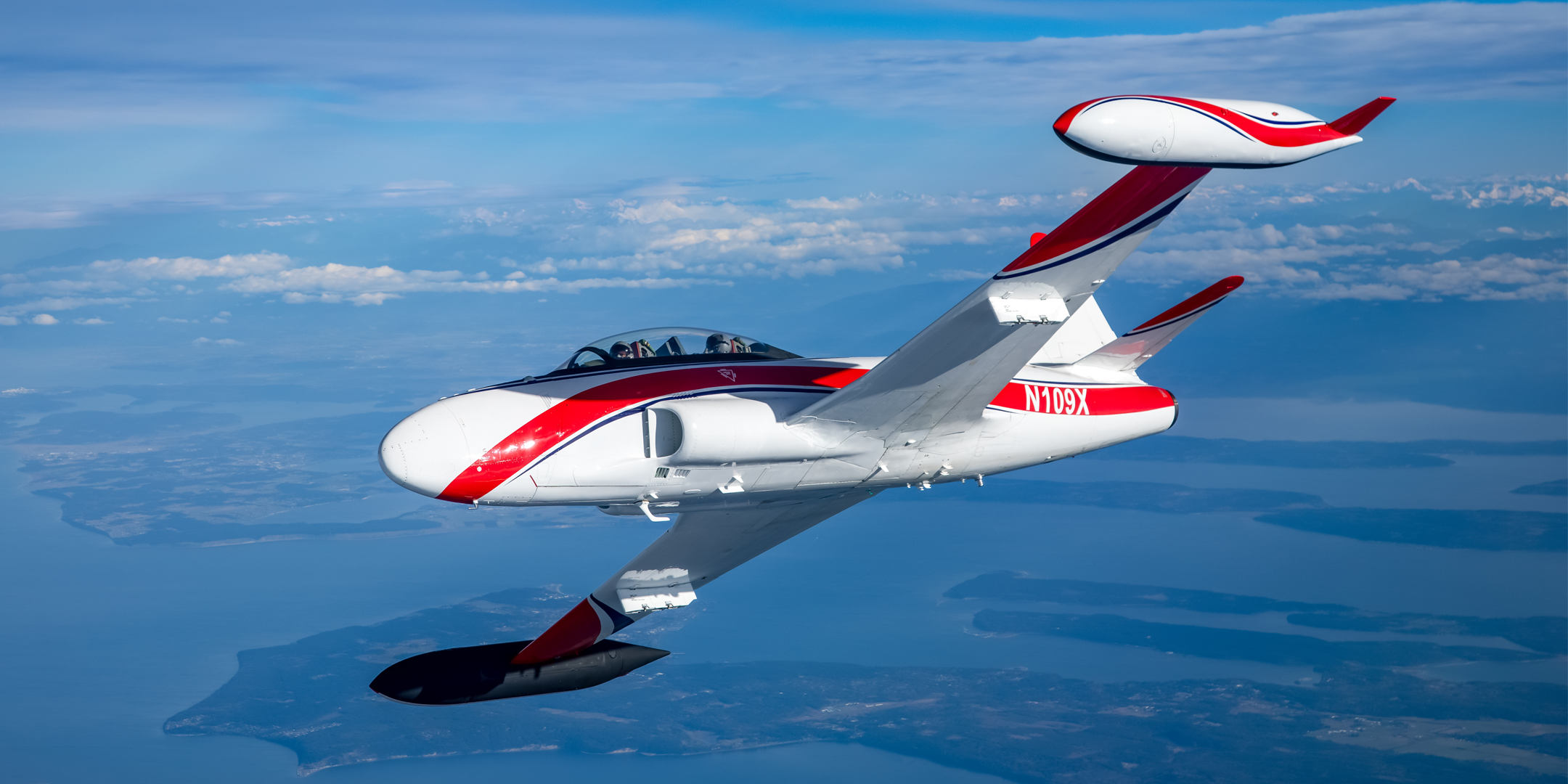
In fall 2026, the Museum welcomed a new plane into the Collection, the Canadair CT-133 Silver Star. Nicknamed “Red Bird” for its distinctive red and white livery, the CT-133 was used by the Royal Canadian Air Force as a trainer for decades. In its afterlife, the diminutive two-seat jet was acquired by Boeing in 1976 to be a chase plane on test flights. With its rugged reliability and large canopy with high visibility for air-to-air photography, it was ideally suited to the task. Today, the CT-133 is on display in the Aviation Pavilion kitty corner from the Boeing 787 prototype that it once tailed. The Aircraft Maintenance team, the Volunteer Office, and the Senior Curator gave me the lowdown on all things CT-133.
The Big Build
Boeing donated the CT-133, and it arrived at the Museum on October 12, 2026. Boeing had disassembled the plane, but it was the Museum’s job to put it back together. Evan Elliott, the Aircraft Maintenance Operations Manager, walked me through the painstaking work of assembling the plane from parts. The process entailed collaboration, finesse, and some colorful language.
“It's like a big puzzle,” Evan explained.
It was by no means the first time the team had signed up for such an undertaking; most recently, they worked on the Learjet 24A in summer 2025. Each aircraft presents its own quirks and sticking points.
The CT-133 is the Canadian license-built version of the Lockheed T-33, which was itself a derivative of the Lockheed P-80 Shooting Star jet fighter built at the tail end of World War II. As a result, it was designed with war in mind, not maintenance, and is rather “ergonomically unfriendly,” according to Aircraft Maintenance Assistant Mike Kloppenburg.
Then there are the inherent challenges of assembling any flying machine. An early win for the team was “mating” (that is the aviation term) the wing to the airframe. One has to precisely line up the bolts with the holes—all while operating two forklifts.
Recalled Evan, “You could be off by a fingernail and the fastener will not go through the spar bolt hole. You got to be right there. So, it takes a lot of finessing.”
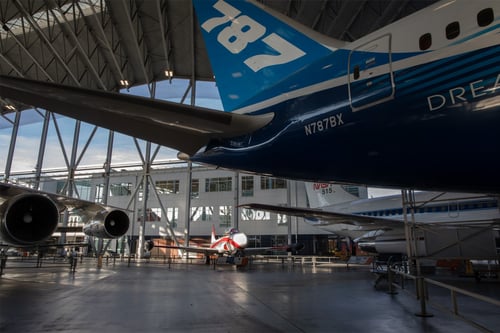
The CT-133 on display in the Aviation Pavilion with the Boeing 787, the plane it chased, in the foreground. Image credit: The Museum of Flight/Ted Huetter
The A Team
Five volunteers, three staff members, and one Boeing technician contributed to the assembly. Volunteers did everything from wing and tip tanks installation to riveting and polishing. With their wealth of aviation and engineering experience, Evan dubbed them “Evan’s army” and “like our right hand.” The volunteer corps can shave off days from an aircraft maintenance project.
“The Museum of Flight has volunteers that serve in a variety of different roles, and one role that is so treasured is our Aircraft Maintenance & Restoration Volunteers who help with the physical labor of restoring and maintaining our historic aircraft both on display and behind the scenes. From former engineers and machinists to anyone who loves to tinker and fix, these volunteers make a big difference in the ongoing preservation work on our historic fleet” - Evan Weber, Volunteer Program Manager
A Storied Career
Boeing operated two CT-133s, the “Red Bird” and the blue-striped “Blue Bird.” The Museum chose the Red Bird specifically for its rich history. It assisted with the development and testing of the AGM-86 Air-Launched Cruise Missile (ALCM). As the Museum’s only slow-speed chase plane, it fills a niche. (There is a high-speed chase plane on display, the Canadair CL-13B Sabre Mk. 6.) Photos of the CT-133 in action show the plane dwarfed next to such giants as the 787 Dreamliner, but playing a critical role nonetheless.
Frank Santoni, a retired Boeing test pilot who flew the CT-133 in the 1980s and '90s, visited the Museum recently to check it out. Chase planes like the CT-133 tail prototypes to identify potential issues, especially ones that the pilot cannot see themselves. Frank would fly within the CT-133 wing’s distance of the mammoth Boeing 777 and 737. As an ex-Navy pilot, he brought his experience in formation flying to bear. CT-133 pilots would also instruct the much larger jets on when to land and take off.
“I am so excited to have one of the Boeing chase planes here at the Museum. The CT-133s chased some of Boeing’s greatest designs, and in the process, helped engineers check the progress of their work. But, they also served as public relations tools as well as flying vantage points for airborne photography. The stories we can tell using this aircraft are going to be amazing!” - Matthew Burchette, Senior Curator
Stay tuned for the stories we’ll be telling about the CT-133 in its new life at the Museum.
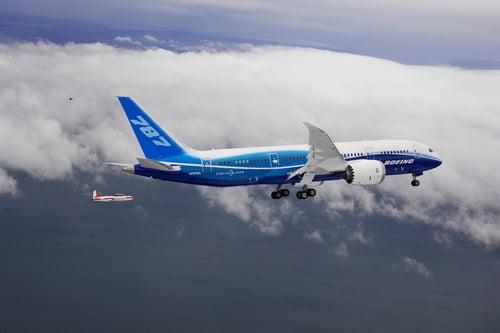
Boeing 787 Dreamliner and photo chase jet on first flight. 787 Chief Pilot Mike Carriker and Capt. Randy Neville tested some of the airplane's systems and structures, as on-board equipment recorded and transmitted real-time data to a flight-test team at Boeing Field. Image credit: Courtesy of The Boeing Company