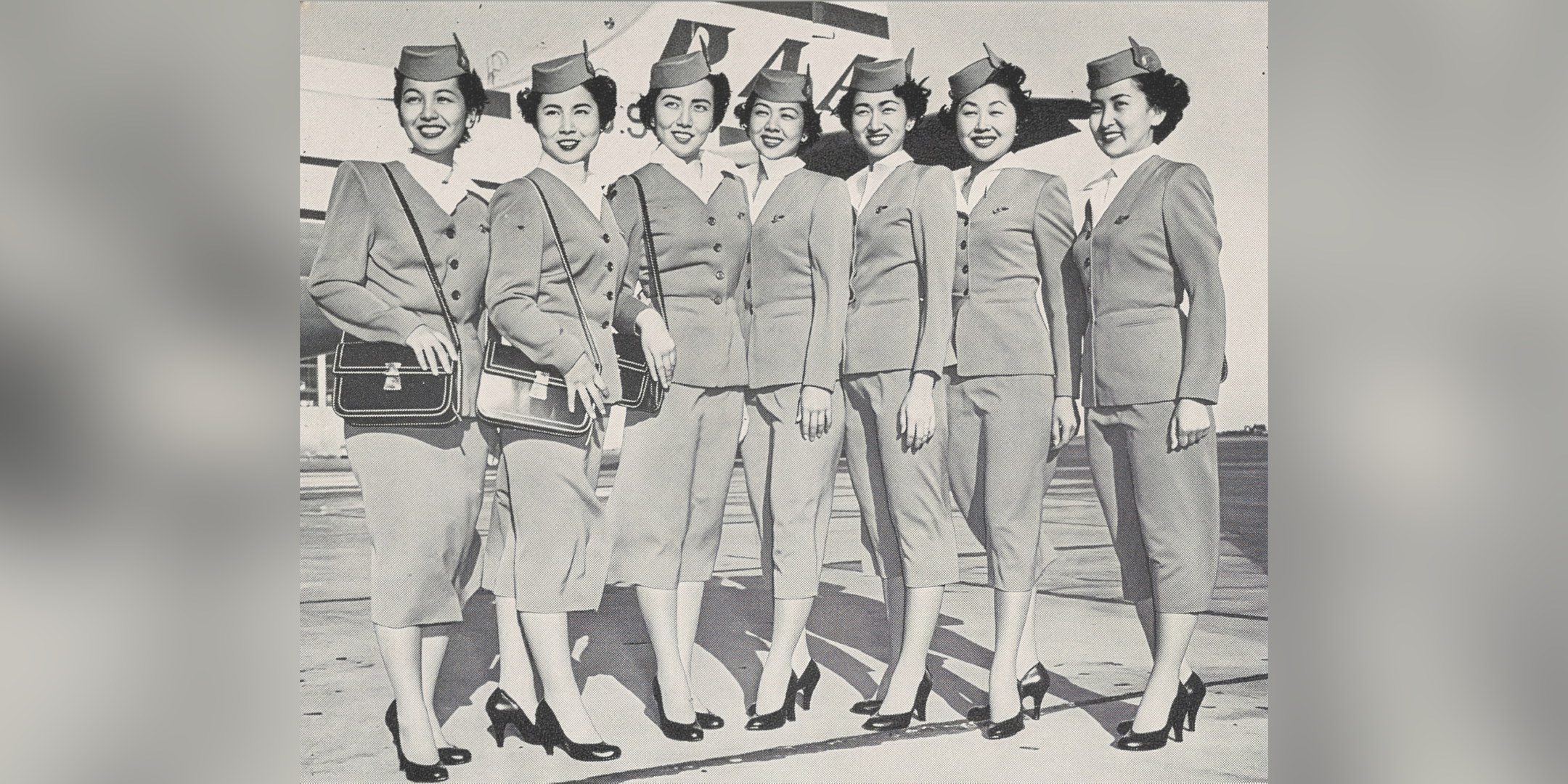
Part 3 in a Jet Age Feminism series exploring the intersection of commercial aviation and gender roles.
Paving the Way
Pan American World Airways, better known as Pan Am. Decades after folding in 1991, the airline still inspires fervent nostalgia; its name and logo remain synonymous with Jet Age glamour. Former Pan Am stewardesses (the term flight attendant did not come into fashion until men joined the profession, in the 1970s) are singularly devoted. Anthropologist Christine R. Yano describes the “continuing sorority of Pan Am,” as epitomized by its spirited retiree club, World Wings International.
The airline’s Nisei stewardesses are a club-within-this-club. In 1955, when being white was an unspoken prerequisite to being hired as a stewardess, Pan Am recruited second-generation Japanese-American (Nisei) women to staff flights between Japan and Hawaii. The move was particularly groundbreaking because it was only ten years removed from World War II, when Japanese-Americans faced widespread prejudice.
The limited-time exhibit Runway to Runway tells the story of this first class of Nisei flight attendants, including Masako “Marian” Tagawa Murakami. Exhibits Developer Mandy Faber was captivated by her story.
“The story of Pan Am’s Nisei flight attendants was a surprise to me when I was doing my research. I had my own perception of what Pan Am was, and what their 1950s flight attendants looked like. When I first came across the Nisei story, it was through the American Experience docuseries on PBS. I quickly realized that women like Marian and the rest of her cohort were breaking barriers much earlier than most people realize. I wanted people to walk away from the exhibit with the same realization I had during my research: Flight attendants were and are on the forefront when it comes to equity and representation in the workplace and we never really knew it!” - Mandy Faber, Exhibits Developer at The Museum of Flight
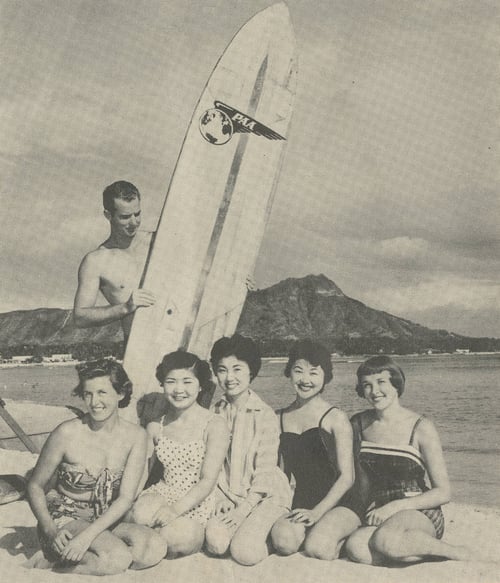
Pan Am flight attendants learn how to surf in Hawaii on their day off, circa 1955. From left to right: Marie Baker, Ruby Mizuno, Betty Okamoto, Masako “Marian” Tagawa Murakami, and Mary MacDonald. Image Credit: Courtesy of University of Miami Libraries, Special Collections
A Matter of Language
Pam Am played up the stewardesses’ Japanese language skills in its announcement: “Only by having such girls as stewardesses can Pan American make the passenger who speaks only Japanese feel at home in the gracious, uncomplicated way that is standard Clipper service” (Airborne Dreams). Yet in reality, there were few Japanese businessmen to pamper. Japan’s economy was still recovering from the war, and besides, the country’s government did not lift its ban on non-official foreign travel until 1964.
In practice, Pan Am sent many recruits to language school. Eventually, the company even relaxed the requirement, owing to the difficulty of scouting Nisei who were fluent in Japanese. Decades of suppression of Japanese culture, from language schools shuttering during the war to more insidious pressures to assimilate into white society, had taken their toll on immigrant families. Ultimately, Pan Am was content to capitalize on the mere perception of these women as foreign. As one Pam Am stewardess recalled, “I think if you looked Japanese and you could speak a little, they were happy to have you” (Airborne Dreams).
As Christine Yano unpacks in her book Airborne Dreams: "Nisei" Stewardesses and Pan American World Airways, the hiring spree was a canny, calculated business decision. The airline bolstered its brand as a cosmopolitan, “exotic” airline with these fresh faces. Author Victoria Vantoch writes in her book The Jet Sex: Airline Stewardesses and the Making of an American Icon, “American airlines with routes to Asia exploited American stereotypes of submissive, obedient Asian women to sell an image of stellar customer service." All-too-familiar prejudices followed the Nisei stewardesses into the air; passengers and other crew alike often made racialized comments.
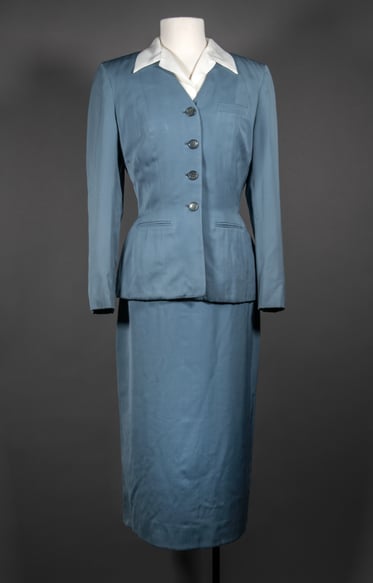
Pan Am uniform from 1952. Image Credit: The Museum of Flight
Looking the Part
Each of the thirteen uniforms on display in Runway to Runway has an equity story behind it, and the Pam Am ensemble is no different, Exhibits Developer Mandy Faber explained. Launched in 1944, the uniform—consisting of a crisp white blouse and blue suit jacket with a matching skirt—was a potent class symbol. As one Nisei stewardess recalled, “I couldn’t believe that I was going to join one of the most prestigious airlines in the world and would be wearing the striking uniform that I had admired from afar” (Airborne Dreams).
Many of these women were self-described “country,” for whom the job of stewardess would have seemed out-of-reach. Self-described pioneers, they paved the way for flight attendants of color, of all backgrounds. Still, such gains in workplace representation were rocky. The first Nisei class was at once tokenized and celebrated, set apart from other stewardesses and bonded to each other. Whatever one thinks of how the program was marketed, its impact is an enduring one. The mantra that many of them live by? “Once a Pan Am stewardess, always a Pan Am stewardess.”
Keep checking the Blog for more entries in the Jet Age Feminism series.
Works Cited:
Vantoch, Victoria. The Jet Sex: Airline Stewardesses and the Making of an American Icon. University of Pennsylvania Press, 2013.
Yano, R. Christine. Airborne Dreams: "Nisei" Stewardesses and Pan American World Airways. Duke University Press, 2011.
Image credit for header: Courtesy of University of Miami Libraries, Special Collections