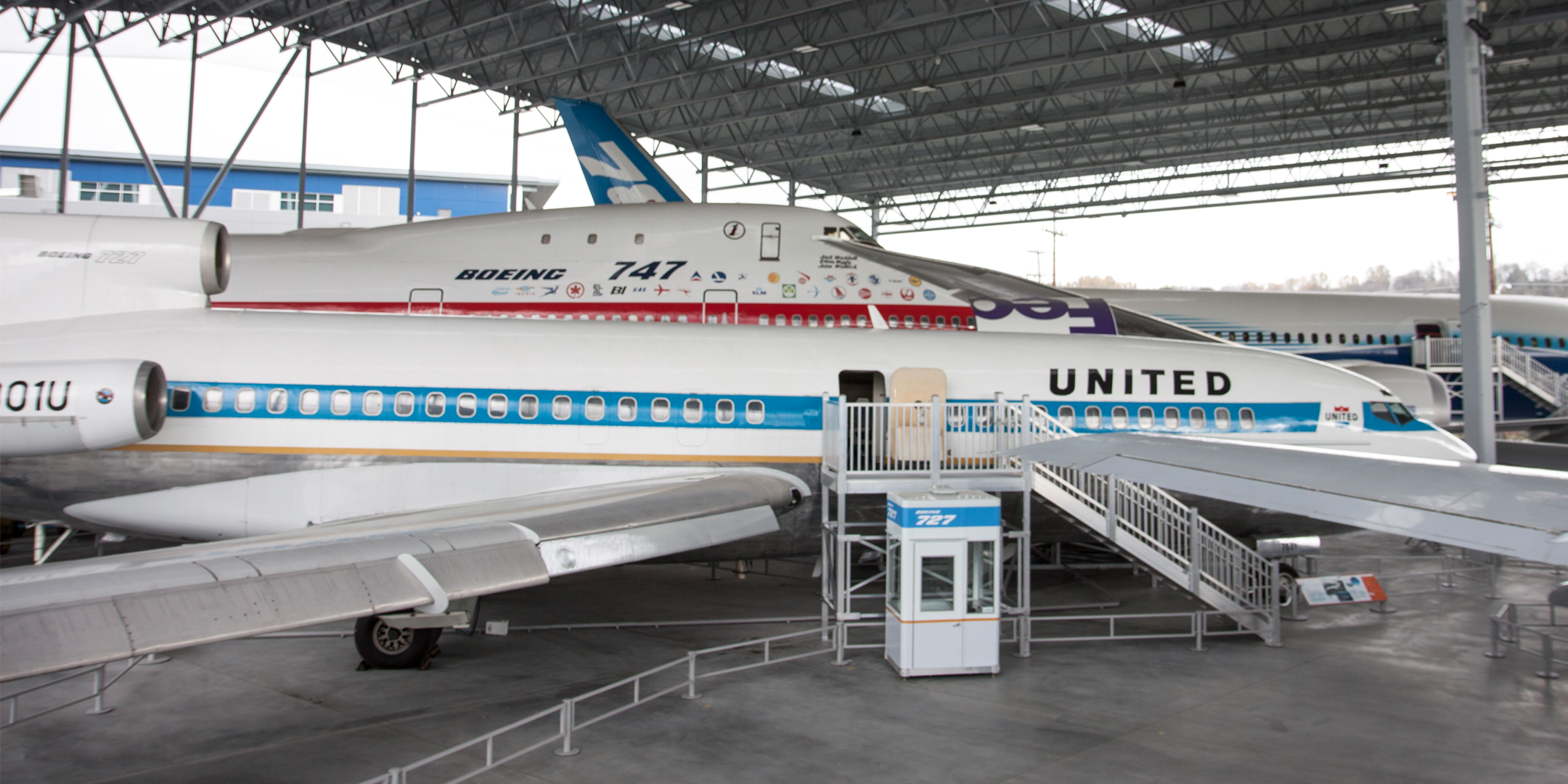
November 27 is the anniversary of the rollout of the Boeing 727. Step back in time with this deep dive into the Museum's own Boeing 727-100, the first 727 ever produced. This article by Senior Public Relations and Promotion Manager Ted Huetter, a.k.a. Museum PR Guy, was originally published in the May/June 2016 issue of Aloft Magazine.
On March 2, 2016, the Museum’s Boeing 727 prototype, 7001U, was flown one last time. It was a brief trip, a 15-minute hop from Paine Field, Everett, to the Museum at Boeing Field, but it was a very long journey to its permanent home at the Museum. This unique jet, originally called E1 at Boeing, had not been airborne since it was donated to the Museum by United Airlines in 1991, and had been under restoration ever since by volunteer crews at the Museum's Restoration Center and Reserve Collection at Paine Field. First flying in 1963, the sleek, innovative 727 introduced the jet age to millions of new passengers around the globe. Now it will kindle memories and create new ones as a testament to times gone by.
The Big Gamble
It may come to a surprise that the Boeing 727—the first commercial airliner program to complete a twenty-two-year production run and sell more than 1,000 airplanes—was considered quite the gamble. The Boeing Company was convinced that the future of commercial air travel was in jets. Jet airplanes were both more efficient and faster than piston-powered airliners. The combination of promised savings in time for passengers and lower operating costs for airlines. The Boeing 707 and its rival the Douglas DC-8 were designed for longer range, intercontinental air travel, but these big and heavy four-engine jet airliners required longer runways for take-offs and landings, limiting their ability to serve medium and short-range routes between cities that had shorter runways. Boeing was faced with the challenge to design an airplane that could combine the short field performance and handling qualities of piston-engine airliners with the high speed of a jet airplane. The design had to allow for operations with a full payload out of airports with runways five to six thousand feet in length, but with enough power to climb quickly to high altitudes for high speed cruise, and fuel for a range of around 1,500 miles. As if this challenge was not enough, the design would also have to be built for multiple take-offs and landings during a working day, operating in all weather with a quick turnaround and low operating costs. Could Boeing design an airplane that could meet these demanding requirements? And, would it be the right airplane for the market?
After three years of design studies, the Boeing Model 727 achieved project status in 1959 with Jack Steiner as Project Manager who assembled a team of talented engineers to resolve the complex design issues. The greatest challenge was the design of the wing; the airplane needed to combine low speed performance and handling qualities with efficient cruise at higher speeds and altitudes. Boeing combined these attributes by using a swept wing similar to the wing on the Boeing 707 with special high lift devices—leading edge slats and Krueger flaps on the front of the wing and triple-slotted trailing edge flaps— that were used for the first time on a Boeing airliner.
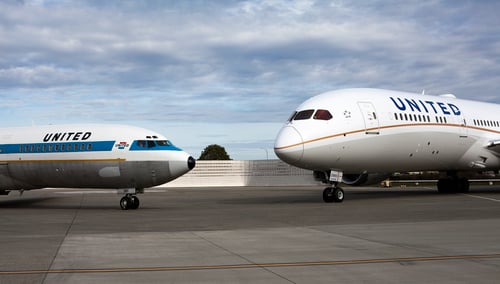
The Museum of Flight's Boeing 727 and 787 posed nose-to-nose on December 17, 2019. Image credit: The Museum of Flight / Ted Huetter
Engine configuration was another headache; some customers wanted four engines for added safety and performance at higher elevations, while others wanted two engines for lower operating costs. Boeing compromised with three engines, and after testing many different configurations placed all three Pratt & Whitney JT8D engines in the rear of the airplane— two in pods on either side of the fuselage and one buried in the tail. To ensure good handling qualities, the Model 727 employed fully powered flight controls, another first for a Boeing airliner. The project team adopted the same fuselage dimension as the Model 707, with the first 727 model accommodating up to 129 passengers in mixed class configurations. To facilitate operations from smaller airports, the Model 727 had its own auxiliary power unit and self-contained stairs at the rear of the airplane and just behind the cockpit.
Boeing formally announced the Model 727 on December 5, 1960, with orders of eighty aircraft from United Airlines and Eastern Air Lines. The prototype 727, N7001U, built for United Airlines, made its first flight on February 9, 1963, with Boeing test pilot Lew Wallick at the controls. Following extensive testing, Boeing sent the prototype on a world tour to drum up more business, covering 76,000 miles and visiting 26 countries. The Boeing 727 made quite the splash, and by September 1972, total orders reached 1,000, setting the sales record for commercial airliners. A Boeing sales brochure from 1979 noted that every 5.6 seconds a 727 took off or landed somewhere in the world, while over the course of one week the world’s fleet of 727s flew more than 3.5 billion passenger miles between 1,889 city pairs in 96 countries. The final Model 727, a 727-200F for Federal Express, was delivered in September 1984, the last of 1,832 727s built at Boeing’s Renton plant.
The Restoration
The Museum is privileged to have the 727 prototype in its collection. The Model 727 aircraft entered service with United Airlines on October 6, 1964 and flew in revenue service for nearly 27 years. During that time the airplane accumulated 64,495 flight hours and carried an estimated three million passengers. In 1984, The Museum of Flight's Chairman of the Aircraft Acquisition Committee, Bob Bogash, approached then-United top managers Ed Carlson and Dick Ferris, and asked for the 727 upon its retirement. United agreed. On Jan. 23, 1988 the airplane was present during an official Museum ceremony a few years before it was retired. On Jan. 13, 1991, the airplane—repainted in its original United colors—flew revenue trip 838 SFO - SEA, and was then ferried to Boeing Field for a final acceptance ceremony at the Museum. It made one last stop—to the Museum's Paine Field Restoration Center. Bogash, a Boeing Company veteran of 30 years, became the 727 restoration project manager.
United removed many of the major parts on the airplane, to use as spares for its remaining fleet of 727s. The Museum was left with a significant challenge with its goal to restore the airplane to airworthy condition. After a few idle years the restoration began in earnest, and grew significantly with the donation of two more 727s for parts. On March 6, 2004, Federal Express donated a 727-100 airplane to the Museum, and in September 2005, Clay Lacey donated a 727-200.
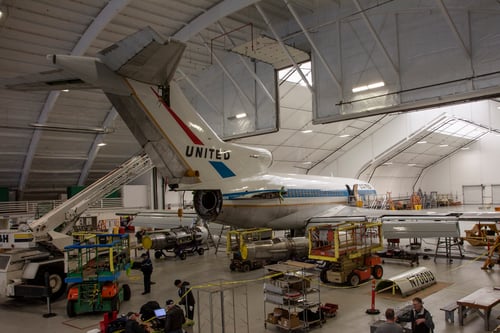
The Boeing 727 in a temporary hangar for restoration work in 2016. Image credit: The Museum of Flight / Ted Huetter
For the past 25 years, dozens of enthusiastic volunteers have helped bring the plane back to life. Terry “TC” Howard, a retired Boeing engineer who was part of the plane's original team at Boeing, has led the restoration effort as crew chief for the past 10 years. FedEx has been a long-time partner on the project, and last year donated the engines for its final flight. Aviation Technical Services (ATS) provided the plane and crews with a new work space for its last couple months at Paine Field. Not everything is free, we hired Global Jet Painting—the group who painted our 747 in 2014—to repaint the 727 in the United livery; SOAR was contracted to be the primary technical entity to complete the restoration for the ferry flight, and began this final, crucial phase in January of this year. And sometimes we just had to buy a thing or two over the past couple decades. But restoration of the 727 was overwhelmingly, remarkably, and decidedly accomplished because of volunteers. Their expertise and equipment for the huge project was international, and from all walks of life.
The Final Flight
The last flight, flown under an FAA Special Flight Permit, was commanded by Tim Powell, a pilot who is type-rated in almost all the Boeing transports, and currently serves as captain for Vallejo Corporation, a company that provides 727 VIP transportation. The First Officer, Mike Scott, and Flight Engineer, Ralph Pascale, also fly for Vallejo Corporation. Rounding out the crew on the ferry flight as Safety Officer was the Museum’s 727 restoration project manager, Bob Bogash. They were the only persons onboard, yet in another way, every one of its 100 seats was filled with the hearts and souls of the volunteers who made the flight a reality.
The countdown to the final flight was followed anxiously by fans from around the world. The Museum’s social media posts reached new highs, Boeing groups became 727 groupies, past and present United Airlines crews were ‘onboard,’ and project manager Bob Bogash said that his internet service provider was complaining that the daily updates on his website were getting so many hits they were crashing their systems.
The final flight was—in the supremely unemotional jargon of the flight test world—“uneventful.” She flew well and looked grand. The landing was sweet. She was welcomed by hundreds of anxious fans at the Museum. Many of them were former United flight attendants and pilots with a personal attachment to the 727. When E1’s engines were shut down after landing, it was not just the airplane that grew silent, the crowd was choked up.
Over the years we have been asked, “why all of this time, expense and trouble to make a 10-minute flight? Why not just truck it?” The reason why is hard to define. It falls outside of the bottom line and it links directly to the heart. The volunteers knew it all along. And that’s what makes it worth it. This airplane got a heart transplant, and that’s what made her fly.
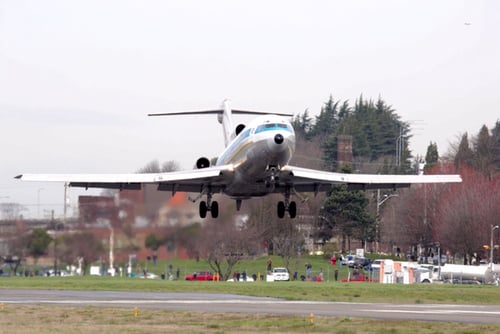
The Boeing 727 landing at Boeing Field on March 2, 2016. Image credit: The Museum of Flight / Francis Zera