"We choose to go to the Moon in this decade and do the other things, not because they are easy, but because they are hard." - John F. Kennedy, Rice University, September 12, 1962. These famous words inspired America to land on the Moon on July 20, 1969, and to conduct additional missions afterwards.
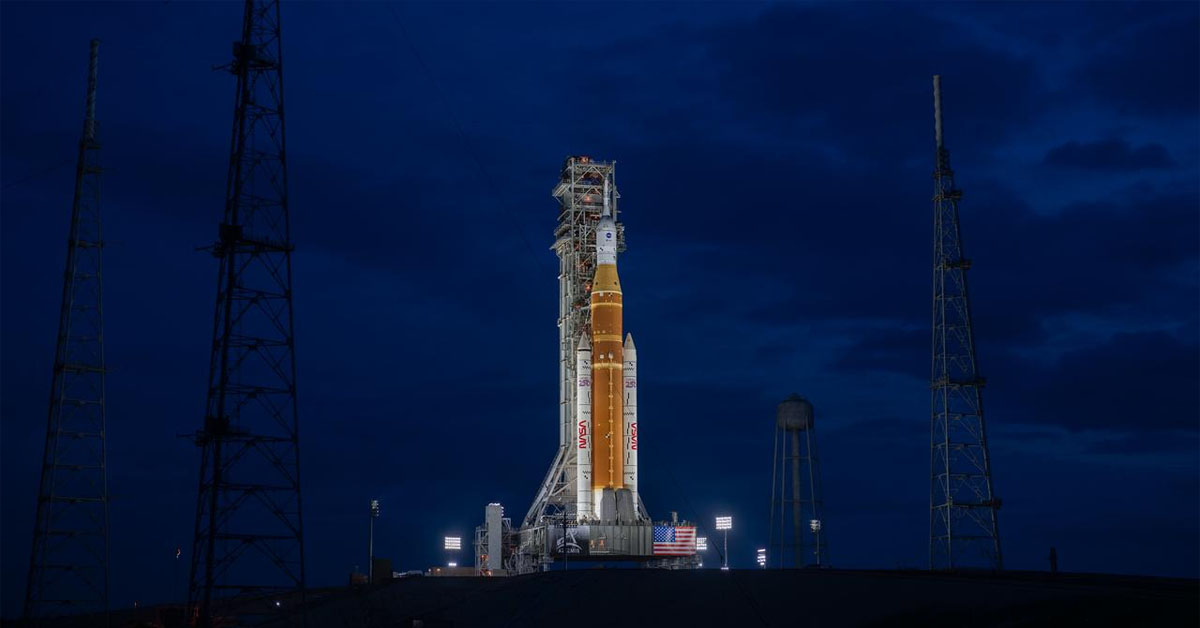
Artemis, named after the Greek goddess of the Moon (twin of Apollo, God of the Sun), represents NASA’s latest attempt to land on the Moon. Composed of three missions, Artemis has already completed one expedition, with the other two upcoming.Artemis I launched November 16, 2022, and landed in the Pacific Ocean on December 11th. It was an uncrewed journey around the Moon and its main purpose was to test the Space Launch System (SLS), the super rocket equivalent to Apollo’s Saturn V (visitors can learn more about Saturn V in The Museum of Flight’s Apollo Gallery Exhibit), and the Orion Spacecraft’s systems.
Artemis II will be the first crewed trek to the Moon since the Apollo 17 mission in 1972. It will launch in September of 2025. The four astronauts selected for the enterprise will not land on the Moon but will fly a figure eight, using the gravity assist slingshot maneuver, around both the Moon and the Earth, reaching further around than any other operation has taken humans. Artemis III will set the first humans on the dust of the Lunar South Pole. It will have a human landing system, provided by SpaceX, which parallels Apollo’s Lunar Module. On the moon the astronauts will collect samples, take pictures, and perform multiple experiments, not unlike previous lunar landings. The mission is projected to launch in 2026.
Why Go Back?
What compels us to set our boots once more on the surface of the Moon? What can Artemis, NASA’s current Moon program, do that Apollo has not already done?
NASA’s stated reasons for landing on the Moon once more include scientific discovery, economic opportunity, and inspiration for a new generation. The Apollo expeditions only covered a small portion of the Moon, leaving much to discover in other regions, like the Lunar South Pole.
Artemis will enable job growth and opportunity, fuel new industries and create demand for a skilled workforce. Through Artemis, NASA will land the first woman, person of color and international partner on the Moon. Apollo made a big step for human technological innovation; Artemis will make a giant leap for cultural advancement and scientific discovery.
Artemis represents the beginning of NASA’s journey to Mars. One of Artemis’ main goals involves having a sustained presence on the Moon, which NASA will accomplish by having longer duration missions, creating a lunar orbiting space station operated by humans and lunar bases on the Moon. Once completed, NASA will work toward taking the first steps deeper into our solar system and to Mars. To reach the distant Mars, NASA needs to prepare with the necessary advanced equipment, spacecraft, and systems, including autonomous systems. The Moon acts as the perfect testing ground for these aspects of the operations.
Apollo & Artemis in the Public Eye
Artemis’ success requires boosting the world’s interest in space. Apollo 11’s television broadcast caught the eyes of millions and had a profound impact on the world’s pop culture and psyche. A crucial part to the success of Apollo involved public support, and NASA did a brilliant job marketing Apollo and keeping reporters in the loop. According to a survey taken by Statista in 2019, 26% of the United States population has never heard of Artemis, and 44.37% are very unfamiliar with what the quests consist of. It would be beneficial for NASA to advertise the upcoming odysseys to the public to help gain the necessary support.
What’s Different This Time?
The era of Apollo differs from today. Going to the Moon back then ended up being more political than scientific: a solo climb rather than an international effort. All of this was due to the Space Race with the Soviet Union. Apollo operated with a near-limitless budget, allowing NASA to focus their efforts on maximizing their chances of success. This time around NASA aims for a less expensive return to the Moon so they may have a sustainable future there.
Despite NASA possessing the leading role in Artemis, international and commercial partners will act as large contributors to the missions. NASA’s commercial contracts will support the agency’s efforts to set foot on the Moon and give NASA the spacecraft they need at considerably lower costs. In fact, just as Boeing once provided the lunar rover for Apollo, the Seattle-founded company designed, developed and tested the SLS core stage for Artemis I. In the future they will build and supply the core stages for other missions. The Odysseus, a craft that landed recently on the Moon’s surface, is the first NASA craft to land on the Moon in fifty-two years. NASA awarded Intuitive Machines a $118 million dollar contract to build Odysseus, which launched on a SpaceX rocket and had multiple other components created by other private companies. These examples show how collaboration can benefit NASA’s efforts to set foot on the Moon. According to Thomas Zurbuchen, former NASA science official, it would have cost at least five times that amount of money for NASA if the spacecraft had been built in the agency’s traditional manner.
With multiple countries and companies conducting exploration, some common rules regarding space exploration become a necessity. In the past NASA has worked with other countries to create agreements such as the Convention on Registration of Objects Launched into Outer Space, the Rescue and Return Agreement, and responsible behavior for NASA and its partners, such as disclosure and public release of scientific data. In 2020, NASA arranged with the U.S. Department of State and seven other countries to create the Artemis Accords. It acted to reinforce the agreed upon principles with an emphasis on collaboration and recognition of common interests regarding space travel. Its main purpose in creation was to advance the Artemis program. When it comes to private companies, they are not tethered to the same rules and regulations that space agencies and countries are tied to. Private companies are not obligated to share scientific data with the public. This could cause problems in the future for organizations such as The Museum of Flight, who compile the information, history and background of these stories to bring them to the public. The Apollo exhibit that visitors experience in the Museum is there because information about Apollo is in the public domain. Will all the information about Artemis be accessible to the public when the Museum is making an exhibit for the next moon landing?
Another difference between Apollo and Artemis is the astronaut requirements. During Apollo, one must have had experience flying jet aircraft as both a test pilot and military personnel. In 1965, NASA began looking for scientists. Applicants needed to have a medical or doctoral degree. In 1972, NASA made two roles for astronauts: pilots, who would command the quests, and mission specialists who would deal with the research and science aspect of the journeys. Artemis will continue to use those roles in the program. Artemis will follow in the wake of Apollo, continuing to focus on a larger extent what the last few Apollo voyages focused on: scientific discovery.
So once again, why go to the Moon? Just as President Kennedy told the world in his speech, we are going to the Moon, not because it is easy, but because it is hard. In the future those words could reference Mars or farther in our solar system, but only if the world works together to go back to the Moon. Artemis works toward that future.
Join us to watch the launch of the Artemis II Mission!

Top image: Lights illuminate NASA’s Artemis II SLS (Space Launch System) rocket and Orion spacecraft at Launch Complex 39B at NASA’s Kennedy Space Center in Florida on 01/18/2026 Credit: NASA/Brandon Hancock