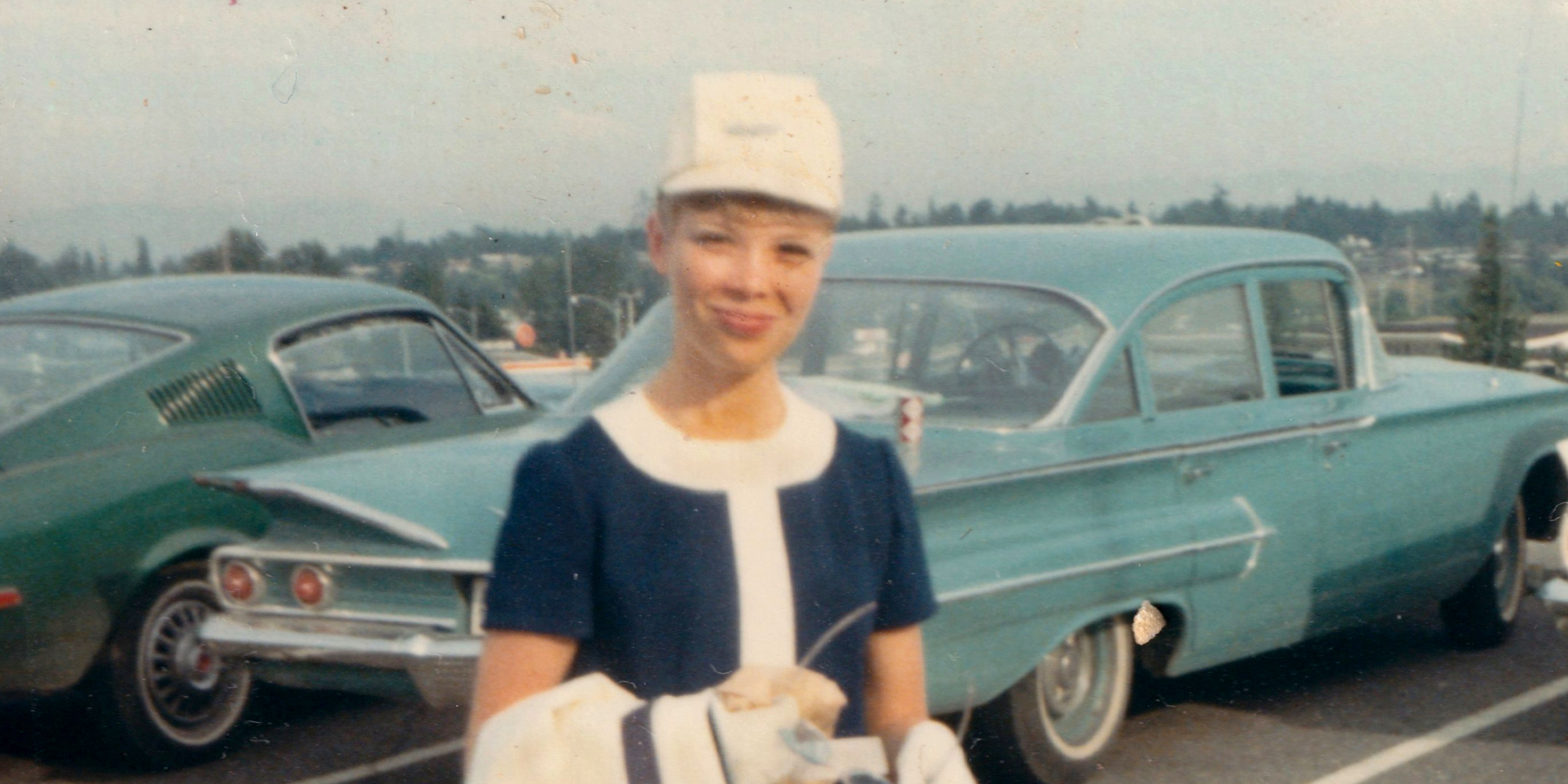
Stories From a Stewardess
Published by
Sean Mobley
on
If you’ve shopped in the Museum’s store, Lynda Eck may have helped you with your purchase. Before she started working here at the Museum, however, Lynda had a 35-year career flying with United, first as a stewardess, then as a flight attendant. She joins host Sean Mobley for a conversation about her career chock full of stories from the friendly skies.
Full Shownotes and transcript after the player.
Link to become a donor. Your gift helps keep this show going!
Link to Mary Hoy episode. Mary Hoy also served as a stewardess for United Airlines. Check out her interview in this episode from the archives.
Link to Lynda’s blog post. Check out some of the photos Lynda shared from her time with United, along with some other stories she didn’t get into on the show.
Transcript
0:00:00
SEAN MOBLEY: The Flight Deck is made possible by the generous donors supporting the Museum of Flight. You can support this podcast and the Museum of Flight's other initiatives across the United States and the world by visiting museumofflight.org/podcast.
Hello and welcome to The Flight Deck, the podcast of the Museum of Flight in Seattle, Washington. I'm your host, Sean Mobley.
If you've shopped at the museum's store, Lynda Eck may have helped you with your purchase. But before she started working here at the museum, Lynda had a 35‑year career flying with United first as a stewardess and then as a flight attendant. She joined me for a conversation about her career chock‑full of stories from the friendly skies.
Lynda, how did you first become a stewardess it was called back then?
LYNDA ECK: Right. Actually, I was on a break from college, and I came back, and my cousin said, "Guess what? I just became a flight attendant, and I'm going to start in about four months." And I said, "Really? That sounds like fun." And I was not having that great of a time in college, so I thought, hmm, when I can, I'm going to call them up and get an appointment, and I did. And within a week, I went in, had the interview. They hired me.
00:01:37
And I was going to be sent off right away, but my cousin is just about four months younger than I am, and she had to be – she wouldn't be 21 until her birthday. So I was already 21, so I said, "Well, I'll wait until you turn 21, and we'll go in together." And so we did. So that's it. And that was – She didn't last quite 35 years like I did, but we – And she flew out of Washington, D.C., and I flew out of San Fran. So we didn't really see each other that much once we graduated from school, but we had a great time in, you know, in stew school.
SM: What year was that?
LE: That was 1968.
00:02:16
SM: 1968?
LE: Yeah, a long time ago.
SM: Now, you did a whole career as a stewardess, as a flight attendant. How long did your cousin end up working?
LE: She flew – I believe she only got in about, oh, maybe 18 years.
SM: That's pretty good.
LE: Yeah.
SM: From what I know of the statistics of flight attendants at the time.
LE: Right. Right.
SM: Both of you did really well.
LE: Yeah. A lot of my compatriots are – Well, actually, some of them have just quit flying, so they lasted a lot longer than I did. I think 9/11 kind of changed my mind about flying.
SM: Yeah.
00:02:52
LE: You know, everything changed after that, and, you know, I just started thinking, well, my family was young, and I just didn't want to take a chance, you know. And who knew what was going to happen? So I lasted until 2003, which was three years after the fact, and I finally turned in my resignation.
SM: Were you flying on 9/11?
LE: No. I was supposed to go out the next day. So I was home when it happened. I was taking care of my dad. And what an event that was. That really affected me a lot. It still does.
SM: How did you see the industry change around you after 9/11?
LE: Well, first of all, there was a lot of security, a lot more security than ever before. There was a lot of flight attendants started taking martial arts to – just to protect themselves on an airplane. There was a lot more sky marshals on the flight. It was just different. You know, you'd walk into a boarding area and instead of being excited about people that you were seeing, you were staring around and saying, "Where is he from? What's she doing?" You know, you'd be more − very aware of who was going to be on your flight, which was terrible. I mean, I remember thinking of, you know, Pearl Harbor and how the Japanese were, you know, kind of chastised about and put down and belittled, and I was doing exactly the same way with people from Saudi Arabia or Afghanistan and all of that. It was just a whole different way, and I'd never been like that with people, never ever.
00:04:41
SM: What airline did you fly for?
LE: I flew for United Airlines the entire career. It was domestic when I started, only domestic. When Pan Am folded and United took over a lot of their Asian flights, I decided to go into the international base, and I started flying international. So probably from mid‑'70s − I'm not exactly sure when we got the routes. I think it was late '79 is when we took over the international routes and I started flying international.
SM: And that's when you started flying on the 747?
LE: Hm‑hmm. [affirmative]. Yeah, 747. United I think took the 747 in early '70s, and it was flown basically on, like, the Hawaii trips, because we did fly to Hawaii. And they've – And the long hauls, like from the West Coast to the East Coast, and those were all flown by very senior flight attendants. And I was very junior, so I didn't fly for them for quite a while. Once international took over, we flew a lot of 747s, which was a great thing. DC‑10s also we flew quite a bit, but 747 was my baby. I loved that airplane.
SM: Yeah?
LE: Hm‑hmm. [affirmative].
SM: You're in those planes all the time; right? So, I mean, those of us – I've been in a 747 a few times when I was a kid, but, you know, we don't notice things. Like what are some of the nooks and crannies or favorite spots on the 747 that you can remember?
LE: A lot of times we had rest rooms that were downstairs. Not restrooms, but – well, break rooms.
SM: Rest area?
00:06:12
LE: Yeah, rest areas. So we would go downstairs. We had, you know, rooms downstairs or sometimes upstairs that we could just take a break from and get away from everybody. Of course, there was always the cockpit. We could always go into the cockpit and hide out.
A lot of times, some of the airplanes had kitchens downstairs. So we could go downstairs and take a little break down there. We took an elevator down, you know, or climb down the stairs, either way. And we could hide out down there or in the galleys. You know, the galleys were the gathering point. So we would hide out there, you know, but, you know, our job was with the people, so we spent a lot of time in the aisles. It was a lot different today. You know, you see the flight attendants maybe once or twice and doing a quick service and then they disappear. Well, we were in the aisles almost all the time pouring water, serving coffee, checking on people, you know. And then there were quiet times when everybody was sleeping, and we'd have a chance to sit down. But once everybody started moving around, we did water checks on the airplane. Probably once every half hour we did a water run. People get extremely dehydrated on airplanes, and I think nowadays you don't get that.
00:07:33
SM: One of the things I do whenever I fly, I take a water bottle and before I get on the plane – It's empty going through security, obviously, and then I find one of the restaurants and just ask them to fill it with ice, no water, because I don't want that ice to melt.
LE: Right.
SM: But I want a cold – I want water so cold on that plane that I'm freezing. I don't know why. You know, maybe it's something I can control, quote/unquote. So it's, like, a thing that I look for. But good cold water is very refreshing.
LE: Yeah, that's true. I'm not – I like cold water in the summertime. I'm not one – I am really not a water drinker. I have to force myself to drink. When we were on the airplane, they used to give us the large water bottles that – and we'd each get two of them, you know, for the trip. And then, of course, there was always water anywhere else. And I would have more trouble getting through one of those. You know, I would have to pour it into a glass and drink it. And everybody tried so hard to get me to drink more water, and I'd say, "But there's a cup of coffee right there," you know.
SM: It's water. It's just got some stuff in it.
LE: Yeah. It's just flavored.
00:08:40
SM: Did you ever fly on such a long haul that you had to have two crews or anything like that?
LE: No. I flew – My longest trip I was ever on was from Seattle to Hong Kong. It's scheduled for a 14, 14-and-a-half-hour flight, but if you hit – the winds change, it turns into almost a 16‑hour flight. And if that's the case, we usually had to stop in Taipei and refuel. And if it was going to go any longer than a certain amount of time, we were taken off in Taipei, and we actually stopped the flight because an airplane can't fly without flight attendants.
So – And so according to our contract, we could only fly so many hours in a 24‑hour period. So we can be scheduled a little bit longer because it'll break the International Date Line and all that. But there was a couple times that we actually said we can't fly anymore. And they didn't have – They didn't have more crews to put on. If they could keep a minimum crew on the flight, they could go on, and the rest of us could get off, but they had to have a minimum of so many flight attendants before they could leave, but there was no second crew even for pilots.
00:10:00
SM: But you had berths and things like that, places in the rest area where you could sleep and things like that –
LE: Yeah. Hm‑hmm. [affirmative]. Absolutely.
SM: …on those long ones?
LE: Absolutely. Absolutely.
SM: I mean, that's such – People don't realize that. We have some of them here, but we can't really get into them. They're not all that accessible like in a 787, and they look quite cramped. It reminds me of, like, a loft in a cabin, you know, type of thing, where you can't quite stand up. You just crawl into it and –
LE: The 747 had one in the back that was like that. It was up above – It was close to the rear galley, and there was a staircase that went up, and you couldn't stand up. You had to kind of walk with your head bent and everything. But once you got into the bunks, it was fine, because the bunks were – They were individual bunks. They had a light. They airflow. They had a curtain that you could pull. So it really was your own little domain in there when you were taking your break. And the same with the one with the lower deck break room. There was one, two, three, four, five, maybe six bunks down there, and they were, like, double‑decker bunks, you know, one up above and one down below and everything. And it was a great place to – I mean, I didn't like it at first because I get a little claustrophobic, but once I got down there and I realized it's not bad at all. So…
00:11:20
Of course, there was a couple times that I got to break in the cockpit. The cockpit, they had a double bunk in their – in the cockpit, in the back of the cockpit. And if there was no one using it and they gave you permission, you could take a break up there, which I did a couple times, and it was so nice. It was very quiet up there. You know, they're busy with their work and carrying on quiet conversations, and you just, you know, I don't know, just relax. It was great.
SM: You probably learned how to fall asleep with noise, too, if you –
LE: Oh, yeah.
SM: …were on an airplane.
LE: Well, especially with triplets at home. There was no problem sleeping. I could sleep at the drop of a hat.
00:12:03
SM: You mentioned your contract. One of the things that I find really interesting about the stewardess and flight attendant world is for a long time it was one of the few unionized workplaces that was dominated by women.
LE: Hm‑hmm. [affirmative].
SM: It's kind of an exception to a lot of labor history in the U.S.
LE: Right.
SM: What were your experiences around that? Were men allowed – For a long time, men weren't even allowed to be stewards or flight attendants. Was that true when you started?
LE: When I started, the only male we had were male stewards out of Hawaii, and they were Hawaii based, and they were the only males I ever saw on a flight were there, and then everything changed in the '70s, you know. And it's the same with the original rules when I started. They were very strict. And then when everything opened up − You know, otherwise I would have lasted until I was 32, and then I would have been out. You know, they politely ask you to leave −
SM: Right.
LE: …because you're an old lady then, you know.
SM: Uh‑oh, I think I'm 32. I've lost track. I'm either 31 or 32, so I'm an old man now.
LE: Yes.
00:13:16
SM: And you bring up a good point. I should clarify, like, it wasn't dominated by women because, like, women were keeping everyone out. It was dominated by women because the airlines were thinking the men should be staring at ladies.
LE: That's true.
SM: You've quoted in a blog article you posted, I think the head of Braniff Airlines who said something along those lines.
LE: They thought that it was right. This may be a little off from the original. But that a man, after a long day at work, should be able to relax, have a drink, and look at a pretty lady. So that was − You know, those were the kind of ads that were going on. You know, even United had one, marriage is fine, but shouldn't you travel first, you know.
SM: Was that an ad for stewardesses or for travel in general?
00:14:03
LE: Actually – Well, it was a – It was a little bit of both, but mostly towards the flight attendants I would think, you know, because they just – they wanted only girls. You know, it was very strict when I was hired. You couldn't – You know, you couldn't have – You had to be between 5'2", 5'9". You couldn't weigh more than 135, and it had to be proportionate to your height. You know, you had to have – I mean, today's standards I think – I look at the hiring regulations for today and what I went through. What I went through is ridiculously easy. You know, I didn't even know what a résumé was until I started working here at the museum. I'd never had one, you know.
So, you know, but you had to – You had to have – Oh, you had to be unmarried. No marriage. You had to – Your hair had to be natural color. It couldn't be dyed. You couldn't – Let's see, what were some of the others? If you had been married, you could have had no children. They would not hire anyone that was married. And you would have to go before a special board in order to be approved because you were a divorcee, which is not – you know, was pretty frowned upon at the time in the '60s, in '68. So it was very, very strict, you know. A high school diploma for sure. Some college would be appreciated, that kind of thing. And public – some kind of public experience. You know, I had been a waitress. I had worked in a – you know, in some kind of a retail store. So those were my experiences as far as being with the public, and they took it. Luckily, they approved me as being one of the chosen few to become a flight attendant. So –
00:16:06
SM: Yeah. Because you said I think again on your blog post 1 in 30; is that right?
LE: 1 in 60.
SM: 1 in 60. Wow.
LE: 1 in 60, yeah.
SM: And both you and your cousin made the cut and made it a long time.
LE: And made it a long time, yeah.
SM: Wow.
LE: Yeah. Hm‑hmm. [affirmative].
SM: When you were a flight attendant, also, that was a time when women were making a lot of strides and becoming pilots and crew. Did you ever fly with a female crew or with a female pilot?
LE: Yeah. I don't think I had any female pilots until maybe on – when I started flying international. I might have flown with – I can't – You know, to tell you the truth, I can't even remember the first female I flew with. You know, it's just one – It's kind of like the male stewards. They just kind of meshed in, and then all of a sudden, there they were, you know. Maybe the first time I saw a female captain kind of set me back a little bit more, only because I thought, oh, my goodness, have they been here that long, you know, to be promoted to captain or to have that many hours underneath their – you know, their work schedule?
00:17:12
So other than that, it was welcoming. It was – You know, it wasn't – I think – Because when you first started flying, you know, being able to go up to the cockpit and maybe flirt with the pilots was kind of a fun thing to do, you know. And now you go up to the cockpit and you can't flirt with the women, you know. I mean, it just – I don't know, they didn't react the same way that you got from the guys, you know. So I don't know.
SM: What are some myths about being a stewardess or a flight attendant that you've kind of heard that you'd want to dispel, or what are some misconceptions people have about that?
LE: There are so many.
SM: Please, let me hear them.
00:17:55
LE: There are so many. Some are true to a certain extent, and I'm sure you'll find that in any –any occupation you go into. Most flight attendants that I flew with were happily married, had families. They would no more fool around on that than anyone. They just – They just wouldn't. Yes, they do fly all over the place. And we've visited so many different places and went – you know, and experienced a variety of things in all different countries. Some good, some bad. But I think anything that you think a flight attendant does or should do or a misconception or that you see in these television shows are all bogus. You know, not all – I mean, a lot of flight attendants were college educated. They had degrees. Some of them had master's degrees. I flew with one that had a PhD. She just wanted to try something different before she went into her field. You know, so they're not dummies that became flight attendants that they could do nothing else. You know, they had a mind. They had goals in life. They had things that they wanted to do, and they were out after it.
You know, being a flight attendant was well‑paying at the time. So we made good money, you know. And all of us were young when we first started. Most of us at the time when I started − you know, as time went on, they hired older people that were beyond 21 years old, you know, which was fabulous. But, you know, it's − I think most people think of flight attendants as being kind blond and dumb. I mean, dumb blonds, you know, that are just out having just a good time and are not – have no brains, you know. And we all kind of went, hey, we're smart. We wanted everybody to know that − you know, and I think that's why we worked so hard to get our contract the way it is now. You know, we are smart. We're educated. We have goals in life. We have families. We have occupations. We have things we want to do. And this is just a means to the ends at some times.
And I think that's what I want to convey to most people when they listen to a – or think about flight attendants, it's – you know, they're different than what you would think about. There are some people that fit right into the mold that you would put a flight attendant, but the majority don't at all. And that's surprising. I mean, I didn't know what to expect. I know when I told my dad I was going to be a flight attendant, and he kind of raised his eyebrows and went, "Really?" Because his idea was just, you know, a floozy of the time. You know, until I gave him his first free ticket, and then he went, oh, this is pretty good, you know.
00:21:11
SM: Well, and I wonder if all the advertising that airlines did to kind of push that image really –
LE: Yeah.
SM: …are the basis of it.
LE: I'm sure. I'm sure it did quite a bit. Yeah, you know, when I was doing my blog and I was doing the research on a lot of things prior to when I was hired, I was surprised at some of ads that went on. But, you know, if you go on to our 747, and they have a picture of all the uniforms that flight attendants wore at the time that the airlines hired the – or bought into the 747. They were –Some of them were very conservative, you know, and then there are some that are a little shorter. You know, and as time went on, into the late '60s and '70s, they became shorter. We had an airline here that had hot pants and go‑go boots. You know, there was one that actually had kind of a helmet on their uniform. Somehow – I can't remember what airline. It could have been Braniff, I'm not sure. It was crazy, you know.
00:22:19
But, you know, but images change throughout the years. Now we're going back to kind of the conservative look. If you look at the uniforms of now, you know, they're not the short, short skirts. You know, when − I remember the shortest one I ever flew was kind of mid‑thigh, you know. And passengers loved it because they'd ask you to put things in the overhead bin. And as you raised your hands, you know, your skirt got shorter. But – So we learned real quick to say, "I'm sure that customer over there would help you put that up there," you know. "Oh, I'm sorry, I have a sore back." We came up with all kinds of excuses.
SM: Clever defense tactic.
LE: Yes. Hm‑hmm. [affirmative].
SM: We haven't really talked a lot about, like, specific memories that you have, stories from the airways.
LE: I had – When I first started flying, because there wasn't a lot of people that flew. So we had a lot of open time, you might say, on some flights, and it was – I loved being able to sit down and talk to the passengers, and you find out the most interesting stories.
00:23:27
You know, I had one lady who knew Margaret Mitchell and who was – when she was sick is when she wrote "Gone with the Wind." And she was saying how they had gone up to her room, and all of her manuscript was all over the room. It had been tossed here and there. She'd write a page and just throw it off and then write another page and throw it off. And so all these pages were all over. And she helped put them all together, and it became "Gone with the Wind." When she published it, they kept saying, "You've got to publish this. You've got to publish it." And – I mean, that was one of the stories, you know, that she put it all together, and I thought it was fascinating.
I talked to another elderly gentleman who told me the story of how he and his family came across the country in a wagon train. Fascinating, you know, stories like that that you hear. I had an experience with a lady – I was doing the service. And this one I always remember because I was taking orders, and I asked the wife what she wanted to eat, and she didn't answer me. And finally her husband turned around and said, "Oh, I'm sorry, my wife doesn't speak to servants," you know. You know, things like that that you kind of go, "Are you kidding me?" But it happens.
00:24:51
You know, that was the sign of the times, because everybody that flew, especially in first class, they wore really fancy clothes. They were hoity‑toity. I mean, they were the cream of the crop, and they decided they wanted to be treated like the cream of the crop. And if for some reason you acted like they were just like everybody else, they were very insulted, you know. It's kind of a – It's kind of a unique situation to kind of play the game of adversary between, you know, the ordinary people that fly and the rich people that fly. Some of them are the nicest people in the world, and that goes for both classes, and some you just want to throw off the airplane. Whenever I hear a story of a flight attendant cracking a door and trying to get off the airplane, I think they've hit the end of the rope and they can't take it anymore. It's kind of a funny situation, but –
SM: On that note, what is one thing passengers can do to just make a flight attendant's day, make them happier or make their job easier?
LE: Oh, happier? Just sit down and just be quiet. You know, we have – You know, I mean, the thing I think that bugs us the most is that people don't understand what it means to keep your seat belt fastened throughout the flight. You know, they have no idea that you can hit – I mean, you are in a tube flying in the air 35, 40,000 feet in the air, and we can drop. You know, I mean, all of a sudden, you hit an air pocket. You go through a cloud, and you have turbulence. You know, people fly all over the place. You know, you could hit the ceiling. You could hit the side of the wall and hurt yourself. You know, they don't understand it. Or that's the moment that they want to go to the bathroom. Well, I'm sorry, you can't sit on that toilet. You know, I mean, if you hit a – First of all, they don't realize all that stuff that's in the toilet is going to come flying up at you, you know. I mean, they just don't understand.
You know, and I think a lot of people, they don't want to admit that anything could happen, and that's why they ignore seat belt signs. You know, how long did it take for us to get people to wear seat belts in a car? A long time. Because it's admitting that you have to be tied down. You know, it's just for their safety. But I think that's one of the things that really bugs us the most is the seat belt sign and then at the time of trying to get people to stop smoking, you know, is another one. People get nervous. They have to do something, so they do it whenever.
00:27:41
I love passengers that really – that help us out, you know, that – whether it's helping other passengers put their luggage in the overhead bin without being asked. You know, I mean, I've asked passengers – you know, like an able‑bodied gentleman trying to help an older lady get her suitcase in the overhead. And I'll say, "Would you mind assisting her?" "Oh, no, not a problem at all." And they'll stand up and help out, you know. It's when you – when they cooperate with what you've asked. You know, if you ask it in a nice way, people will do just about anything.
SM: Kind of the flip side of that, what are a few of your tips for a comfortable flight, after having so many in your life?
LE: Well, actually, I worked on most of I mine. I never got to sit that much.
SM: That's fair.
00:28:30
LE: But I would say when I go on a vacation, first of all, I usually bring a neck pillow just to relax my neck. We used to have pillows and blankets on airplanes. They don't anymore, but we used to have a lot of them. So we could hand it out to −every person on the airplane got one. So a neck pillow for one.
I would suggest if you can – Because the leg space is so limited, if you can put your suitcase in the overhead, do it. The only thing I bring on an airplane is usually a backpack. I can put it underneath the seat in front of me and move it to one side so I can stretch out. You know, do little exercises just to keep the circulation going in your feet. You know, even if it's just sitting in your seat and raising your feet back and forth, you know, it helps keep the circulation going. Drink lots of water. I know, listen, Lynda, this is your advice. In fact, I usually bring my own water bottle or I bring my own coffee cup because I don't like drinking out of the – Anything that makes you comfortable, think of what you want to do. Sometimes I bring my own slippers because I take my shoes off when I fly, and I just put slippers on. It's much more comfortable.
SM: I'll have to remember that for next time.
LE: Yeah.
SM: So, yeah, you mentioned smoking. You were also, I guess, a flight attendant during the time when smoking stopped being allowed on domestic flights.
LE: I flew when it was so bad. I remember leaving out of London and Japan. Both of them were terrible smokers. And the back of the airplane would turn blue, and I mean blue, after takeoff. You just – It just − Everybody lit up. And it was – I mean, I hated flying coach just because of that. You'd just sit there and cough the whole time. So we were very happy when it stopped.
00:30:27
SM: Had you ever flown before you became a stewardess?
LE: Yes, I did. I took a – We went on a big family vacation to Europe right after I graduated from high school. And we were gone for about a month. So we went to a variety of different countries that we flew to. So that was my only experience flying.
SM: Hmm. Do you remember what that first flight was like?
LE: It was exciting. I can remember just sitting by the window and just staring at the ground disappearing underneath me and just being thrilled by the idea that I was in the air. I was so excited. I can remember for the six months before this trip actually took place, I was so excited. It was – I just thought I'm going on an airplane. I'm going on an airplane. You know, when I hear somebody say they've never been on an airplane, I'm just stunned nowadays because it seems like everybody has been on an airplane, but that was a thrill in a lifetime. Probably like an astronaut taking off, you know, that thrill of taking off to space.
00:31:42
SM: Thank you for tuning in to this episode of The Flight Deck, the podcast of the Museum of Flight in Seattle, Washington.
Special thanks to those who have made financial gifts to support the podcast. It's because of you that we can bring these stories to the public for free. You can become a donor at museumofflight.org/podcast by clicking the yellow Donate button.
Another way to support the show is to rate us on Apple Podcasts or wherever you downloaded us from or by sharing the show with folks on social media.
Now, Lynda is not the first to the first flight attendant I've had the pleasure of interviewing for this podcast. I'll include some links in the show notes to other episodes featuring women aviators or women crew members, and you can find those at museumofflight.org/podcast.
If you want to walk in Lynda's footsteps, you can in the aviation pavilion here at the museum. Several aircraft out there are open for visitors to walk through, including the first Boeing 747 ever built. You can also learn about Ellen Church, one of the first flight attendants, in several places around the museum, especially near our Boeing model 80 display. And you can contact the show at podcast@museumofflight.org.
Until next time, this is your host, Sean Mobley, saying to everyone out there on that good Earth, we'll see you out there, folks.